Wind Indicators – Reading Conditions and Interpreting Flags
Reading the conditions is trying to work out where your bullet will end up in a particular condition. Let’s say in a perfect condition, where there is no wind at all, no boiling pockets of air, mirage, etc., you have adjusted your scope for an aim point at 12 o’clock on the bull and for the bullet to hit the middle of the bull.
The below is a basic explanation of where the bullet will hit in a certain condition:
Wind Left to Right (red on BRT flags) bullet will print a little low and to the right
Wind Right to Left (green on BRT flags) bullet will print a little high and to the left
Head wind (blue/red prop on BRT flags) bullet will print a little low
Tail wind (blue/white prop on BRT flags) bullet will print a little high.
It is important to remember that there are many other conditions that may not be as obvious or easy to deal with, such as pockets of air, mirage, wind in multiple directions and lot’s more. But try and work out what you can see first.
You may have noticed that in a straight crosswind there is some vertical movement in the bullet. The reasoning behind this is because of the rotation of the bullet, clockwise in this case.
I have no definitive proof of this but after many shots on target and discussions with other BR shooters, this theory seems to make most sense.
Shooting a match, I first shoot a couple of sighters and if possible one on green condition and one on red condition. This gives me an idea of what the two conditions are doing to my bullet.
I then try and find a prevailing condition, shoot at the record target and if it prints where I estimated it should, I try to get the next four shots in as quickly as possible before the condition changes but taking care to shoot without disturbing the bag. If the bullet drops lower, higher or further left or right then what I estimated, I will chase the bullet but only by half of where I estimated the bullet should be in relation to where it actually hit. Reason for this, the second and subsequent shots may end up with the same amount of movement as your first “wayward” shot so less chance of a major mistake. The other option of course is to go to the sighter target and check again where your bullets are landing.
Sometimes you’ll get those days where the wind is switchy and variable and there is just no real prevailing conditions. At times like that you may need to shoot more sighters to try and work it out, maybe get a couple of shots on the record and back to sighter again but I always try and finish it off once I’m on the record target.
When at a match, spend some time just watching the flags. It will help you get a feel for the range and any patterns in wind behaviour that may be typical for that range.
The diagram below is an estimate and is very much dependent on multiple other factors.
An important one is the tune of the rifle and that’s another topic of it’s own. If the rifle is not in tune, you will have twice the problems trying to figure out the wind as you won’t know what’s throwing that bullet out of the group. And of course you have to be confident in your equipment and your gun handling before you can get a good feel for what effect the wind has on your bullet.
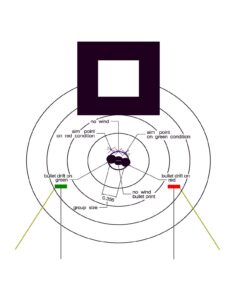
Try and shoot a few test targets before a match (day before), and shoot five shot groups. Holding the same aim point, shoot the extreme red and green conditions and everything in between so you can have a good idea of maximum bullet drift.
You will end up with nice big half inch or more groups but this gives you a better sense of what the wind is doing to the bullet on match day at that particular range.
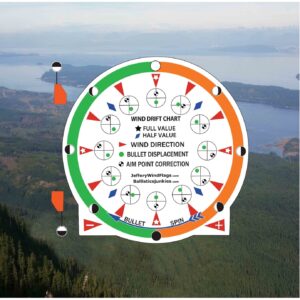
The wind drift chart below goes in to a bit more detail