
Paul Sullivan HoF 16
If you have ever shot a short range Benchrest match in Australia, centrefire or rimfire, you would probably have come across Paul Sullivan.
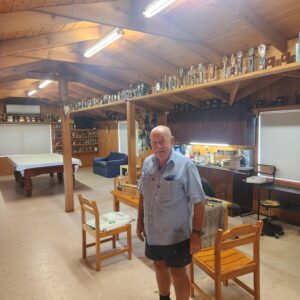
Sully needs no introduction to most Benchrest shooters in Australia and many around the world but his achievements are worth noting. He is our highest ranking Hall of Fame member, extraordinarily, in all four of the Benchrest short range disciplines.
In Centre Fire he has amassed a total of 86 points, Rimfire 37 points, IRB with 14 points and Score where he has 56 points. (Numbers are correct at time of publishing this article in 2024)
Sully has won the Benchrest Bulletin shooter of the year title on many occasions in both Rimfire and Centrefire as well as numerous Nationals and State four gun championships. He has represented Australia on many occasions and was part of the Australian teams winning the Centrefire World Benchrest Two Gun Championship title on two separate occasions, South Africa in 2009 and New Zealand in 2017.
Top Gun Manufacturing is Paul’s gunsmithing operation. He is an accomplished gunsmith and over the years has chambered hundreds of barrels and imported many quality components such as actions, barrels, triggers and other items which are not readily available in Australia.
Many shooters were welcome at his home to test their rifles and equipment in his 100 yard tunnel where a rifle can be tested and tuned without the external influence of wind and heavy mirage.
I had a chat with Paul and asked him about his journey in the world of precision Benchrest shooting.
G’day Paul, can you tell us how you got interested in Benchrest shooting?
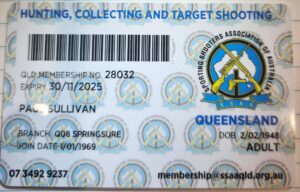
Well I got interested in rifle accuracy when I was roo shooting as a young bloke. We were getting paid to shoot kangaroos , so no head shot meant no money. As you would appreciate, accuracy became very important to me. My grandfather taught me to shoot with a 32-20 which had a Lyman 2 power scope mounted. A group of us shooters started shooting Benchrest at Emerald under a tree somewhere and then finally we moved to Springsure where we shot for many years until the range was closed just recently. We had a group of shooters there and we all joined SSAA on Jan 1, 1969.
Did you have a mentor who helped you in the early days?
Yes, Albert Zahle who was the president of the Springsure club at the time and coincidentally he is Gavin Marshall’s grandfather. Irving Hagan was another one who helped me along the way. Harold McKee, Peter Nesbitt and a few others were always helpful.
You’ve shot matches all over the world in both centrefire and rimfire. Which are your favorite ranges to shoot at in Australia and around the world?
Without a doubt my favorite Australian range to shoot at is Dairyville at Coffs Harbour and I enjoyed shooting at the Warwick range in QLD.
Internationally St Louis would be up there with the best and I very much enjoyed shooting at the Lohtaja range in Kokkola Finland.
Who was the toughest competitor you competed against over the years?
There has been scores of them, every year there would be a few shooters who were hard to beat. Steve Sori used to stir it up a bit with his “must beat Paul Sullivan” note posted on the wailing wall. Internationally Tony Boyer was on top for a very long time so he was ultimately the hardest competitor.
He is also a friend who I spent a lot of time with, he taught me most things I know about benchrest shooting.
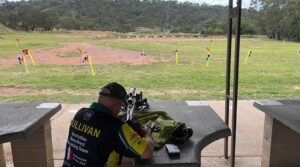
Most CF Benchrest shooters load at the match so they can tune their rifle by adjusting their loads. I noticed that you often don’t load at the range and come preloaded for a two day shoot. Can you give us an insight on the advantages and disadvantages of both loading at the match and pre loading at home.
I started preloading at home since I acquired the Sartorius scale and dispenser with which I can achieve extremely accurate and uniform loads to within 0.02 of a grain. The other advantage of pre loading is that you can relax a bit more by not having to rush and load ammo all day, specially during a 4 day shoot The disadvantage of course is that you don’t have the scope to change your load during a match if your gun happens to go out of tune.
I personally only shoot centrefire, but for someone who shoots both rimfire and centrefire, can you tell us if there is a different set of skills required?
The rimfire is a lot more sensitive to shoot in terms of wind effect, and it does teach you a lot about how the wind moves a bullet. I believe this helps me with my CF shooting as well. The trouble is, I tend to over compensate when I shoot CF thinking the bullet should move but it doesn’t. That’s why it is important to shoot sighters and when you see a bullet go somewhere you don’t think it should have, believe the sighter, because that’s where it went!! There are other things as well like recoil and just the noise level of a CF v RF which also take a bit of getting accustomed to if you are going from RF to CF. A Rimfire bullet takes longer to exit the barrel so your gun handling is critical. In CF you have to be able to tune your rifle with a powder / seating depth combination and in RF it’s the tuner at the end of the barrel and of course ammunition selection that comes in to play.
You have had many achievements in Benchrest shooting, what do you consider your best and proudest achievement?
One of my first goals in Benchrest was qualifying for the Hall of Fame and I achieved that back in 1994.
Winning the two Teams World Championships, particularly the first one in South Africa 2009 would have to be at the top of the list.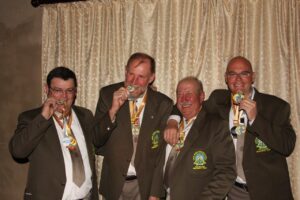
Paul with Brendan Atkinson, Stewart Elliot and Craig Whittleton, Gold Medalists South Africa 2009
Precision shooting of any kind can be a bit daunting for someone new to the sport, particularly shooting in an organized registered match. What advice can you give new shooters who are a bit reluctant to have a go?
1 replies to Paul Sullivan HoF 16
Thank you gentlemen for sharing these insights into one of our great benchrest shooters. David and I have both benefited from Paul’s mentoring and guidance. Paul is always happy to share his knowledge and experience in a very positive and supportive manner. And he has a great sense of humour!